
Court-Appointed Counsel vs. Privately Retained Defense Counsel
Facing charges for a crime is one of the most terrifying situations, regardless of whether or not the charge is a misdemeanor or a felony.

Do you know that a defendant must pay for appointed counsel at the end of the case?
If charged with a criminal offense, the accused has a few choices. They can enlist the services of a seasoned attorney or request a court-appointed attorney to represent them, free of an up-front cost. An appointed lawyer is not free; the court requires reimbursement for the lawyer’s fee after the case.
At LEWIS & DICKSTEIN P.L.L.C., we have worked with dozens of clients seeking our help after being dissatisfied with a public defender’s inattentive and subpar representation. Unfortunately, the adage “you get what you pay for” is true in the case of legal representation.
Does it matter who represents me? Is a court-appointed attorney the same as a retained lawyer?
Choosing a seasoned, reputable attorney to protect you is crucial, whether you face misdemeanor or felony charges for the first time or the third! We have heard from clients that their public defenders fail to communicate, leaving phone calls and emails unanswered, and leaving the clients unaware of their own choices and personal rights. Other common complaints include that the lawyer does not fight to win, is disrespectful, lacks knowledge, appears uninterested, refuses to hold meetings, and more. Not all court-appointed lawyers fit this description; many are very good, but heavy dockets and a lack of financial incentives limit their effectiveness.
Because a public defender is court-appointed and chosen by the court or judge, clients forfeit the ability to select a seasoned attorney when they request a court-appointed attorney. In fact, some public defenders are overextended and will try to get clients to plead guilty to avoid going to trial, which requires more planning and investment. The worst-case scenario occurs when judges punish court-appointed lawyers for fighting cases by removing them from “the list” or assigning them less frequent work.

What if I can’t afford a lawyer? Should I request a court-appointed attorney?
It is worth researching attorneys in your area before assuming you cannot afford a lawyer and requesting a court-appointed attorney. While you may hesitate to set up a payment plan, consider what is at risk if you lose your case. Your reputation, finances, employment, family, and freedom are all at stake. For this reason, we do not recommend cutting corners. With years of experience, we can help devise a defense strategy to minimize the potential damage to your life and livelihood.
When deciding whether a lawyer is affordable, you have to consider not only the amount of the fees but also ask the question, “What is the cost of not hiring a good attorney?” What if the case does not go as well as it could, and the judge orders jail time, or the jury convicts the defendant? What if you could have avoided that simply by investing in yourself? What would be the defendant’s cost in terms of lost employment, time away from family, deportation, damage to reputation, inability to go to college, or getting a professional license? The odds are good that the “cost” of an unnecessary jail sentence or conviction is far greater than the difference in the cost to hire a highly respected lawyer.
Can I get a court-appointed lawyer if the police accuse me of a crime but haven’t charged me yet?
Unfortunately, someone accused of a crime but not yet charged is not entitled to court-appointed counsel under either Michigan law or federal law. The lack of a right to effective representation on a pre-charge basis puts those suspected of criminal activity at a severe disadvantage. Anyone facing allegations of criminal activity has rights; however, without an attorney, they will be left without someone to help protect them. For example, everyone has a Fifth Amendment right to remain silent and a Fourth Amendment right to be free from illegal searches and seizures. The police can trick even knowledgeable individuals who are aware of their rights into incriminating themselves by manipulative and deceptive police officers. Make no mistake, police officers are not running around seeking “justice.” They are building cases and seeking evidence to obtain convictions. Because the suspect of a crime is not entitled to a public defender, they must utilize every resource possible to hire a lawyer.
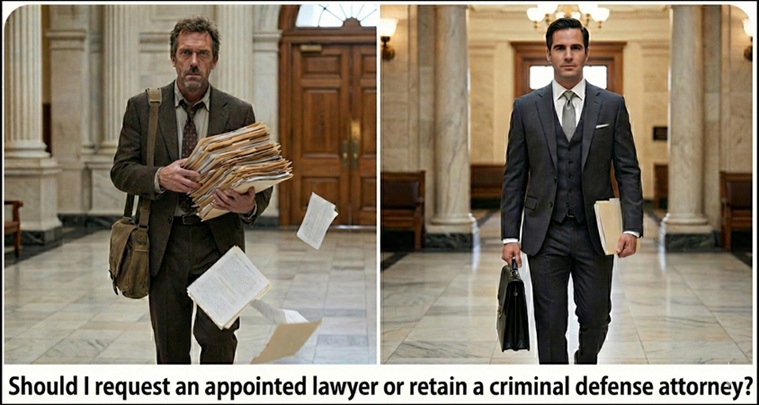
What should I look for when hiring a criminal defense attorney?
Individuals with no prior experience in the legal process often find themselves unsure of what to look for in an attorney. Before hiring a bargain lawyer or requesting a court-appointed attorney, consider whether a lawyer specializes in cases, has a strong reputation, if their prior clientele vouches for the lawyer, and how the various lawyer rating services rate the lawyer. Be sure to ask whether the lawyers you hire will handle your case or if random lawyers will show up in court.
Is a court-appointed attorney free?
A court-appointed lawyer is not free; there is no up-front fee. The court will force the defendant to reimburse the court when they request a court-appointed attorney. The judge will order the defendant to reimburse the court as a condition of the sentence. Failure to make a payment can be a violation of probation. The court-appointed attorney’s fee will be a fraction of the cost of a retained lawyer; however, the quality of the representation may also be a fraction of what it would be with a seasoned, experienced, and zealous private attorney.
How do you qualify for a public defender in Michigan?
To qualify for a Court Appointed Attorney, a person must be “indigent.” A judge or magistrate typically determines indigency at the arraignment hearing. While there is no exact definition of who is “indigent,” some definitions include a person 25% above the poverty line or less. At the arraignment, the judge informs the defendant of the charges and determines bail. A defendant appearing for an arraignment without an attorney is at a severe disadvantage. A retained lawyer will prepare for an arraignment by obtaining a thorough history from their client, gathering supporting documents (such as proof of employment), arranging for character witnesses, advising the client on educational or therapeutic programs, and more. A retained lawyer gives a defendant the best chance of remaining free on bond while the attorneys litigate the case.

Top Legal Representation for Felony and Misdemeanor Cases
The Defense Team with LEWIS & DICKSTEIN, P.L.L.C. is widely known and respected for having an unparalleled track record of successfully and zealously representing our clients. We use a unique team approach, with several seasoned criminal defense lawyers collaborating on every file to achieve the best possible outcome. Our attorneys understand that money doesn’t grow on trees, and anything you spend on legal fees is less you have to use for you and your family. When you trust LEWIS & DICKSTEIN, P.L.L.C. with your defense, we will do whatever it takes to ensure you get the best possible value for your hard-earned money. Our team will do everything reasonably possible to protect and defend our clients. We will find a way to help you!
If you are considering requesting a court-appointed attorney, call us for a free consultation to discuss your situation. We will take the time to talk with you, answer your questions, address your concerns, and help you make the best choice for you and your future.
Call us today at (248) 263-6800 for a free consultation or complete an online Request for Assistance Form. We will contact you promptly and find a way to help you.
We will find a way to help you.
We Are Not Afraid to Win!